You profile has been submitted for review.



Dr. Vikaspal Singh Forestry subject - Forest ecology, Forest Nursery,
No reviews yet
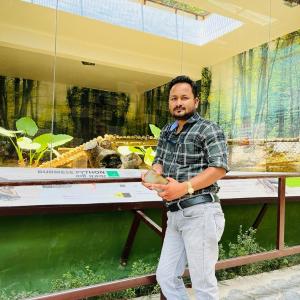
I have 20 years of research and 11 years of teaching experience in B.Sc. forestry and M
Sc. Forestry subject.
I have Doctorate degree in Forestry from HNBGU Srinagar Garhwal, A central University, Uttarakhand, India.
I have specialization of forest ecology and have research work in temperate Himalayan region of tehri district of Uttarakhand, India.
I can deliver lectures on silviculture, introduction of forestry, Forest Nursery Management, Medicinal and aromatic plants, Fundamentals of wildlife, wildlife management, Biodiversity and conservation.
Beside these all I can also assist research work in forestry field both as field and lab based work.
I can more explain the theory part of forestry subject with field experience with proper online platform.
Subjects
-
Environment Beginner-Intermediate
-
Biodiversity and Conservation Beginner-Expert
-
Forest Silviculture Beginner-Expert
-
Forest Ecology Bachelors/Undergraduate-Doctorate/PhD
-
Forest Nursery management Beginner-Expert
Experience
-
Associate professor (Sep, 2017–Mar, 2026) at Dolphin PG Institute of Biomedical and Natural Sciences, Dehradun, Uttarakhand
Teaching and research of forestry subject
Education
-
PhD (May, 2008–May, 2014) from HNBG GHARWAL UNIVERSITY UTTARAKHAND
Fee details
₹500–1,000/hour (US$5.26–10.53/hour)
600
Courses offered
-
Silviculture
- ₹700
- Duration: 6 Weeks
-
 Delivery mode: Online
-
 Group size: 11 - 20
- Instruction language: English
-
 Certificate provided:
No
Certificate provided:
No
Introduction to Forests, Forestry, and Tree Biology: Definition and classification of forest and forestry. Branches of forestry and their relationships. Trees and their distinguishing features. Forest reproduction – flowering, fruiting, and seeding
behavior.
Climatic and Environmental Factors Influencing Forest Vegetation Site factors: climatic, edaphic, physiographic, biotic and their interactions. Classification of climatic factors: role of light, temperature, rainfall, snow, wind, humidity, and evapotranspiration in relation to forest vegetation. Bioclimatic and microclimate effects.
Soil, Topography and Biotic Influences in Forest Ecology
Edaphic factors: influence of biological agencies, parent rock, and topography on soil formation.
Soil profile, physical and chemical properties of soil, mineral nutrients. : Physiographic factors: influence of altitude, latitude, aspect, and slope on vegetation. Biotic factors: influence of plants, insects, wild animals, man, and domestic animals on vegetation.
Classification and Distribution of Indian Forest Types
Forest types of India: basis and systems of classification, revised classification of forest types of India. Major groups: Tropical, Montane Sub-tropical, Montane Temperate, Sub-alpine, and
Alpine. Subgroups: types, species composition, and distribution. Forest types of Uttarakhand.FOREST ECOLOGY AND MANAGEMENT
- ₹700
- Duration: 6 Weeks
-
Delivery mode: Online
-
Group size: 6 - 10
- Instruction language: English
-
Certificate provided:
No
Population ecology: definition, population dynamics and carrying capacity.
Speciation: sympatric and allopatry. Population growth models. Population distribution: characters of forest communities. Community ecology: species interactions. Ecological succession: definition, terminology, basic concepts, theories of succession; climax vegetation types.
Production Ecology and Species-Level Ecology
Production ecology – primary and secondary production – Paterson’s productivity index. Autecology of important tree species.
Biodiversity and Its Assessment
Biodiversity: definition, levels of study, distribution of diversity in life forms, hotspots of biodiversity, world mega biodiversity countries. Biodiversity of Nanda Devi Biosphere Reserve. Measurement of diversity and diversity indices. Endemism; categories of endemism. Rarity and extinction of species; threat values of species, categories of existence.
Conservation Biology and Global Initiatives
Principles of conservation biology, ex-situ and in-situ methods of conservation.
Genetic and evolutionary principles in conservation. Sacred groves; concept, uses. Biosphere concept. Conservation – efforts in India and worldwide. National
Biodiversity Authority (NBA): salient features of NB Act, Convention on Biological
Diversity (CBD), Access and Benefit Sharing (ABS).

-
-
Dehradun, Uttarakhand, India
-
Can travel:
6.22 mi (10.0 km)
-
- Last login: Jun 1
- Registered: Mar 26
- Total Teaching exp: 10.0 yrs.
- Teaches online: Yes
- Online Teaching exp: 3.0 yrs.
- Teaches at student's home: Yes
- Homework Help: Yes
-
 Gender: Male
- Works as: Individual teacher
- Speaks: English, Hindi
-
Fee:₹500–1,000/hour(USD 5.26–10.53/hour)
Reviews
No reviews yet. Be the first one to review this tutor.